Three examples of better industrial pre-engineering
When an industrial-scale plant investment, a production bottleneck or ageing equipment requires a solution, good pre-engineering helps identify the right way forward before major commitments are made.
When the need for pre-engineering for an industrial investment arises, our client’s question is not whether pre-engineering has been carried out. The question is more practical: Is the idea viable? What equipment is needed? How can a functional overall solution be built? And how can uncertainty in decision-making be reduced? In this article, we answer these questions through three real-life examples.
Example 1: Turning uncertainty into a manageable plan for moving forward
What we did: We identified the aspects of the project that caused the greatest uncertainty and compared different implementation options. We looked for ways to improve energy efficiency and make more effective use of process streams, and we defined clear next steps for moving the project forward. To compare the implementation options, cost estimates were prepared for the selected alternatives. To achieve a sufficient level of accuracy in the cost estimates, preliminary layouts, mass and energy balances, and budget enquiries for the main equipment were prepared for the selected alternatives. Construction costs were estimated at a preliminary level based on the layouts.
What the client received: A clear plan for the next stages of the project, a well-founded choice of the solution to take forward, ways to save energy and reduce emissions, as well as a more realistic schedule and better predictability from a production perspective.
Expert Mikko Peltomäki. Project Manager Mikko Peltomäki brings extensive experience in manufacturing production, operational management and investment projects to pre-engineering. His experience helps identify, already at the design stage, solutions that will also work in practice in production, maintenance, safety and commissioning.
“There are many things to manage in the day-to-day operation of a production plant. The time and internal resources available for development and planning are often limited, which means we can cost-effectively bring additional resources and expertise to the project. Instead of uncertainty, the client gains a clear decision-making path that enables the project to proceed in a controlled manner towards implementation.”
Example 2: A good idea, but is the investment viable?
Starting point: Our society, indeed the world as a whole, generates waste fractions that cannot be utilised. In Finland, one such waste fraction was treated by incineration, with the resulting ash deposited in a landfill. Our client had developed technology that would enable valuable raw materials contained in this waste fraction to be recovered for reuse.
What we did: Our client had excellent knowledge of the process they had developed. For financing purposes, an overall investment cost estimate with an accuracy of +/- 25% had to be prepared. In addition to binding quotations for the main equipment, achieving this level of accuracy also requires a more detailed cost estimate for the parts outside the process itself. We were needed to design the plant on an industrial scale, including all utility systems, required structures, buildings and yard areas. Based on these plans, it was also possible to estimate piping costs, auxiliary equipment costs, automation, instrumentation and electrical costs, building services costs, structural costs and construction costs with sufficient accuracy.
What the client received: A reliable overall investment cost estimate and sufficient input data for project implementation.
Expert Leena Pirhonen. Department Manager Leena Pirhonen approaches investment ideas in industry and the energy sector as techno-economic entities. In her work, concept development, energy and mass balance calculations, and profitability assessments are combined to support decision-making.
“A phased approach to engineering before the investment decision improves the conditions for a successful investment. Phasing is not an engineering consultancy’s way of productising services, but the client’s way of managing an investment project. The information produced in the previous phase provides the basis for making decisions. There is no point in preparing an overall investment cost estimate at the highest possible level of accuracy for every potential alternative.”
Example 3: A new piece of process equipment is more than just an equipment purchase
Starting point: A piece of process equipment that had reached the end of its life cycle needed to be replaced. At the same time, there was a need to update the design and ensure that the new equipment, piping and their connections would form a functional whole within the existing environment.
What we did: We designed the placement of both the new reactor and the associated piping. The layout was developed together with the client to make it more functional, taking into account not only the production process but also equipment operation, maintainability and the necessary safe access routes. The diagrams and piping connections were redrawn in a clearer format and updated to reflect the planned overall solution.
What the client received: A feasible solution in which the equipment’s space requirements and integration with the existing system had already been considered before procurement. This meant that potential space, installation and compatibility issues could be identified at an early stage, providing the project with significantly clearer starting points for implementation.
Team Elina Majuri and Heikki Karhu. Lead Process Engineer Elina Majuri brings expertise in process systems, equipment sizing, P&I diagrams and safety assessments. Lead Layout and Piping Engineer Heikki Karhu ensures that the process can be positioned, connected and constructed as a functional whole.
“In day-to-day engineering work, challenges are identified as early as possible. Using 3D models, layouts and process reviews, we coordinate the different engineering disciplines and identify potential problems before they emerge on site, in production or in maintenance. The earlier the challenges are identified, the more smoothly and cost-effectively they can be resolved.”
The right things at the right time
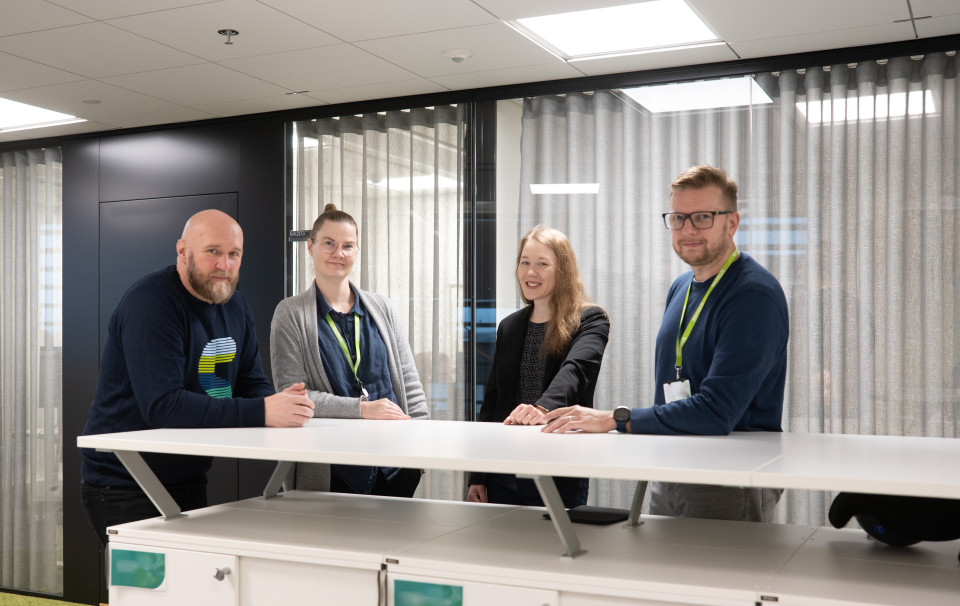
Pictured Mikko Peltomäki, Elina Majuri, Leena Pirhonen and Heikki Karhu.
An industrial investment is not merely a process or equipment project. Its success may simultaneously require, among other things, permitting, infrastructure, architectural, structural and building services engineering, project management, construction management and supervision, as well as information management.
However, not everything is done at once. The key is to identify the questions that are most important for decision-making at each stage, bring together the right experts to resolve them, and produce precisely the information needed for the next decision. In this way, the right things are done at the right time, the project proceeds in a controlled manner, overlapping work is reduced, and requirements related to engineering, permitting, construction and maintenance can be anticipated before they result in additional costs or delays.
Do you have an investment idea, a need to expand production, an ageing process or an entire project where the next step is still unclear?
Get in touch. We will assemble a team suited to your needs and help determine what should be done now, what should come next and what can wait until later.